



Ho Chi Minh City's skyline across the Saigon River. The capacity Vietnam needs will be built here, but not yet on terms most foreign lenders accept. Photo: Cuong Doan, Unsplash.
Vietnam is being pitched as Southeast Asia's next data centre market, and the case is easy to understand. Banks are digitising quickly, the government wants artificial intelligence capacity at home, and data residency rules encourage companies to keep their data inside the country. BMI, a research firm, counted about 148MW of operating capacity in July 2026, with 79MW under construction and more than 870MW announced or planned. Most of that pipeline has yet to reach a building site.
Growth, though, is not the same as an investable opportunity. The question for an Australian infrastructure investor is whether a Vietnamese data centre can be financed today, and on what terms. On the evidence available at the start of October, the answer is that it can, but selectively, and mostly alongside a Vietnamese partner.
How a data centre gets financed
A data centre is built before it earns anything. The owner spends heavily on land, buildings, power and cooling, then rents space and electricity to customers who install their own servers. Smaller customers such as banks and local companies rent capacity by the rack, which is known as colocation. The largest customers are the global cloud companies, such as Amazon Web Services, Microsoft and Google, which can take an entire building on a long contract.
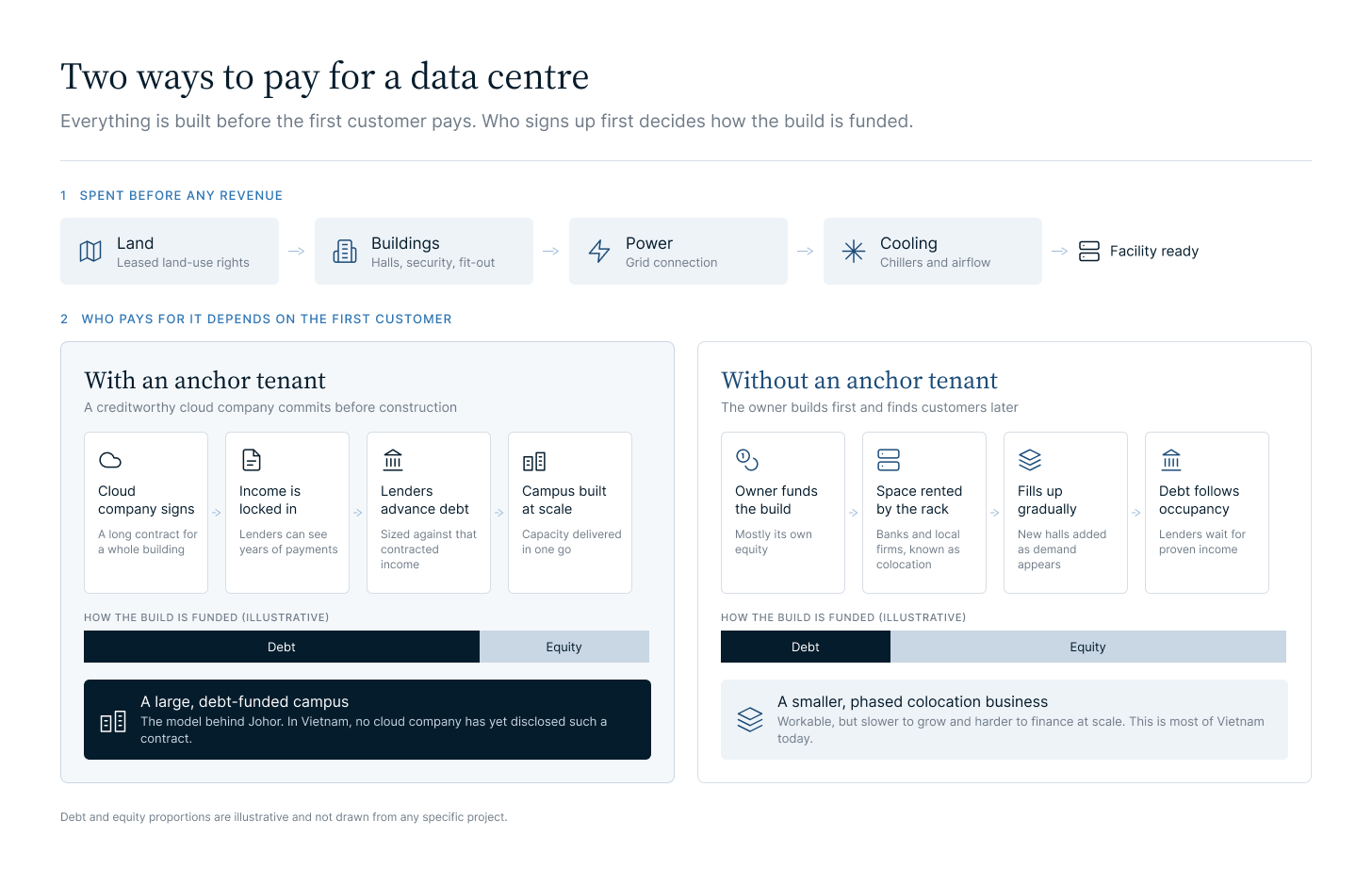
That long contract is what makes a large project financeable. When a creditworthy cloud company signs up before construction, lenders can advance debt against a predictable income stream. Without such an anchor tenant, the owner funds the project mostly with its own equity and fills it gradually. Both models can work, but only the first supports the kind of large, debt-funded campus that has driven growth in Malaysia's Johor.
What the demand evidence shows
The global cloud companies are moving into Vietnam, but so far as customers of the local market rather than as anchor tenants that would underwrite new campuses. Amazon Web Services opened a Local Zone in Hanoi in June, which AWS says brings computing and storage into the country and helps customers meet data residency requirements. It is, however, an extension of AWS's Singapore region rather than a region of its own, and it is sold on a pay-as-you-go basis with no long-term contracts. In February, G42, the Abu Dhabi technology group, signed a framework agreement with FPT and Viet Thai Group to deploy cloud and AI infrastructure across three sites, backed by a commitment of about A$1.4 billion, Middle East AI News reported. That is a genuine build programme, but it is still at the framework stage, awaiting regulatory approvals and site development. Neither announcement ties a cloud company to a long lease on a specific facility, and that is the commitment a lender needs before funding a large build.
BMI expects Google and Alibaba to open their first hyperscale facilities in Ho Chi Minh City from 2027. Neither company has said so, and BMI itself warns that delivered capacity is likely to fall short of the pipeline unless power, grid capacity and international connectivity improve.
Why land terms decide which sites can be financed
Foreign investors in Vietnam do not buy land outright. They lease land use rights from the state for a fixed term, and a lender needs that term to outlast construction, the customer contract and the loan, with time to spare.
That requirement explains a project that fell away in August. VNG, the Vietnamese technology group, disclosed that it would buy back STT GDC's majority stake in the company holding a data centre site in Ho Chi Minh City's Tan Thuan export processing zone, for about A$27 million, subject to regulatory approval. TNGlobal reported that the land term there ends in 2041, which was considered not optimal for a hyperscale facility, and VNG now plans to use the site for offices and staff facilities. With only fifteen years of land left, a facility opening in a couple of years would not have outlasted a typical long-term cloud contract.
Newer sites are different. In August and September, Ho Chi Minh City granted 50-year leases running to 2076 in Saigon Hi-Tech Park to two projects with Singaporean backing, Evolution DC and Starmason, worth about A$1.4 billion between them. Starmason is 51 percent owned by Vietnam's BB Holdings and 49 percent by Sembcorp. Foreign-backed projects, in other words, can get long leases. The chart below sets the old and new sites against roughly what a financed project needs.
The detail lies in how the rent is paid. Under Vietnam's Land Law 2024, as the law firm Allens explains, land users in hi-tech parks may pay rent up front for the whole term, while those paying annually cannot mortgage the land use right. The Investor reported that Evolution DC will pay annually. Starmason chose a lump sum with an exemption that applies if it meets certain conditions, but Allens notes that exempted rent may have to be repaid if the land is transferred, possibly including when a lender enforces its security. Long leases are available, but leases a lender can comfortably lend against are rarer.
The electricity price is still in dispute
Electricity is one of a data centre's largest running costs, and in Vietnam its price is contested. A ministry circular that took effect in December 2025 moved data centres serving outside customers onto the higher commercial tariff. After operators protested, the trade ministry issued guidance in April that the technical systems inside data centres should pay the cheaper manufacturing rate. Yet Viet Nam News reported on 21 September that Ho Chi Minh City's power utility was still billing commercial rates, leaving Viettel and CMC with disputed bills worth billions of dong. CMC and other private operators told VietnamNet their power costs rose by more than 50 percent over three billing cycles.
The official tariff schedule shows why the complaint is credible, and what is at stake. Under the retail prices published by EVN in May 2025, a mid-voltage customer on the manufacturing tariff pays 1,833 dong per kWh in standard hours, while a business customer pays 2,887 dong, 58 percent more. The gap is 35 percent in off-peak hours and 48 percent at peak, which is consistent with the increase operators reported.
Translated into money, the difference is large. As an illustration, a facility running one megawatt of servers around the clock, with total site consumption half as much again to cover cooling and other overheads, uses about 13 million kWh a year. Weighted across EVN's peak, standard and off-peak hours, the business tariff costs about 998 dong per kWh more, which adds roughly A$730,000 a year for each megawatt of IT capacity. For a 60MW campus of the size Starmason plans, that is about A$44 million a year at full use. Real bills would be lower while a facility fills up, but scaled to the projects now planned, the sums explain why the industry petitioned and why an investor cannot treat the tariff as a detail.
Who bears that cost depends on the contracts. Many colocation agreements pass power costs through to customers, which shifts the risk to tenants and makes Vietnamese capacity more expensive to rent. Where they do not, the owner absorbs it. Until the dispute is settled, either the operator's margin or its competitiveness is exposed.
What it means for Australian investors
Australia's two data centre platforms have so far stayed out. NEXTDC's FY26 results name Kuala Lumpur, Tokyo and Auckland as its offshore markets, and AirTrunk lists seven markets, from Japan to Saudi Arabia, but not Vietnam. Both are putting capital where large cloud contracts are already signed, so Vietnam is not a factor in their near-term earnings.
For a superannuation or infrastructure fund looking at a Vietnamese project, five questions matter. How much land term is left after construction, the customer contract and the loan? Is the rent paid up front, and can the land be mortgaged? Who is the tenant, and how good is its credit? Which electricity tariff applies, and can costs be passed on? And is the price low enough to pay for the uncertainty that remains? The table below applies the first four to the three Ho Chi Minh City sites in the news, and none of them yet passes every one.
On today's evidence, the most practical route is a minority stake beside a Vietnamese majority partner, with protections over major decisions, future funding and exit. Listed exposure is available through FPT (HOSE: FPT), CMC (HOSE: CMG) and Kinh Bac City (HOSE: KBC), subject to foreign ownership limits, though data centres are only one part of each business.
What to watch through 2027
Three developments over the next fifteen months will show whether this caution is justified.
The first is a full cloud region. None of Amazon Web Services, Microsoft, Google or Alibaba has announced one for Vietnam, and with the power price, regulatory approvals and international connectivity still unsettled, it would be a surprise to see one announced before the end of 2027.
The second, and the one most likely to prove this view too cautious, is a named tenant at the new hi-tech park sites. If Starmason or Evolution DC signs a global cloud company as its anchor before the end of 2027, the case for financing large campuses in Vietnam changes quickly. That is a genuinely open question.
The third is how much of the pipeline actually gets built. Operating capacity could nearly double from 148MW and still finish 2027 below 300MW on BMI's measure, which looks the more probable outcome. That would leave most of the 870MW announced still on paper.
Vietnam has shown it will grant foreign-backed projects long leases, and its need for onshore computing is not in doubt. Until a global tenant signs and the power price is settled, the best opportunities will be found alongside Vietnamese partners, at prices that pay for the wait.
General commentary only. Not financial product advice. Information current to 6 October 2026; currency converted at RBA rates of 2 October 2026.