



On 26 September 2024, Hurricane Helene reached Spruce Pine, a small mountain town in North Carolina.
Flooding cut roads, power and communications. Above the town, the two companies producing its high-purity quartz suspended operations (NPR).
For roughly two weeks, one of the world’s most concentrated industrial supply chains stopped moving.
Not oil.
Not chips.
Not rare earths.
Sand.
Spruce Pine produces quartz pure enough to manufacture the crucibles used to grow silicon ingots. Those ingots are sliced into the wafers inside solar cells and semiconductor chips.
Estimates vary, but quartz from this one district is used in roughly 70% to 90% of the world’s silicon-growth crucibles, with BloombergNEF putting the share above 80 percent (Grist).
The feared shortage never arrived. Inventories held, and production restarted within weeks (Sibelco).
That looked like resilience.
It was also a warning.
The industry had enough inventory to survive a short shutdown. It did not have enough alternative supply to make Spruce Pine irrelevant.
The mines restarted.
The dependence remained.
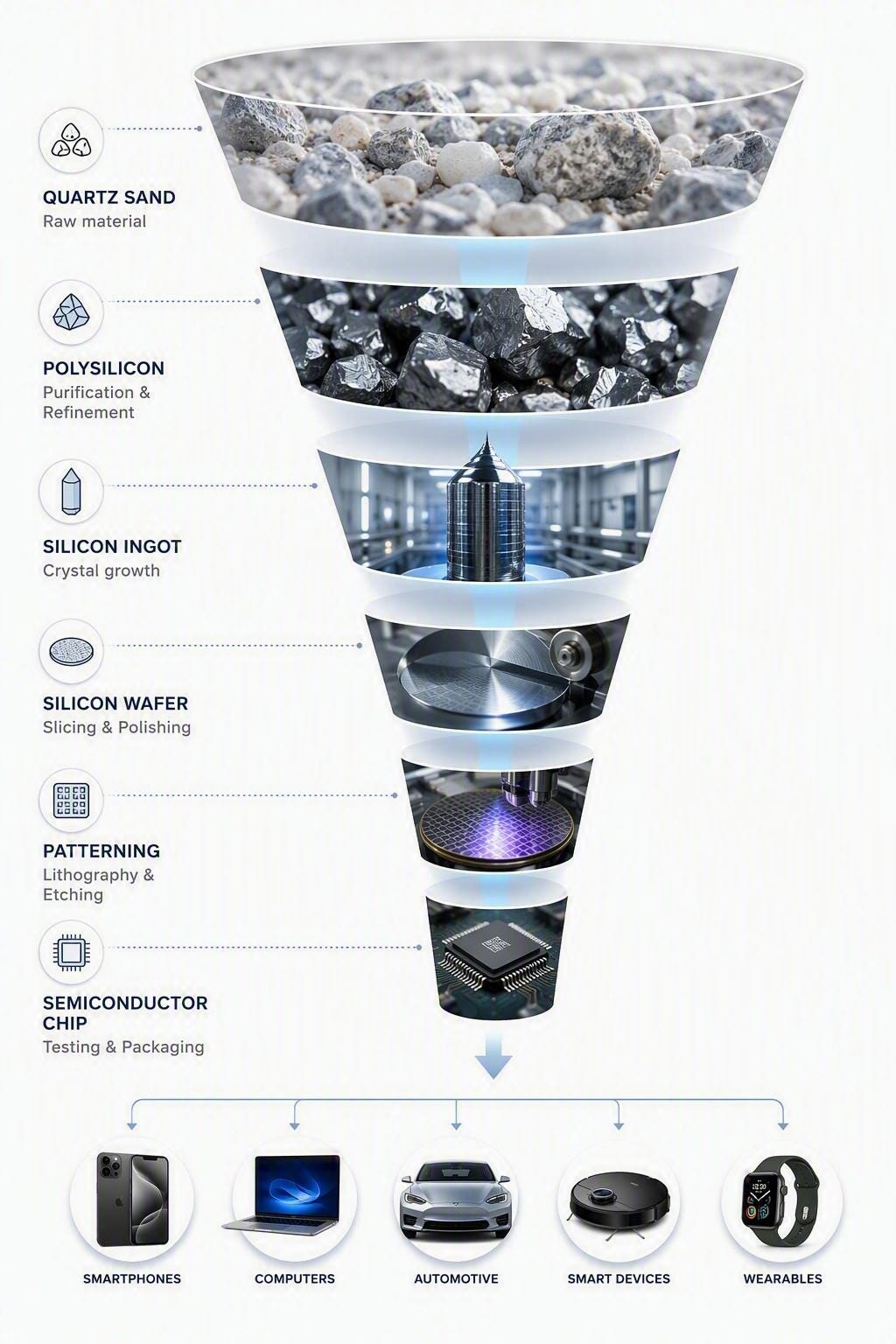
The Billion-Dollar Wafer Starts Inside a Disposable Bowl
The chain looks simple. Sand becomes silicon, silicon becomes an ingot, the ingot becomes wafers.
Most industry diagrams stop there. The commercial opportunity sits in the step they leave out.
Inside an ingot furnace, silicon is heated beyond 1,400 degrees Celsius and kept molten for days. A seed crystal is lowered into the liquid and slowly pulled upward, forming the cylinder that will eventually be sliced into wafers.
The silicon cannot sit inside an ordinary metal container. At that temperature, even tiny amounts of contamination can damage the crystal growing above it (Construction Physics).
It needs a vessel made from exceptionally pure quartz.
The silicon leaves the furnace as a valuable ingot.
The quartz crucible does not.
The furnace is bought once. The crucibles keep being ordered.
That difference creates the business model. Every new furnace creates another customer. Every replacement crucible creates another sale.
Call it the crucible toll: the recurring cheque every ingot puller writes to whoever controls qualified five-nines sand.
Spruce Pine’s advantage is not simply that its quartz is pure. It is that customers already trust it.
A wafer manufacturer considering a new supplier is not comparing two bags of sand. It is comparing a possible saving on the crucible with the potential cost of a failed production run.
A lower price means little if contamination reduces wafer yields or ruins an ingot.
That calculation favours the incumbent.
Each successful furnace cycle produces more performance data, more customer confidence and another reason not to switch. Spruce Pine owns the geology, but its harder-to-replicate advantage is customer approval.
Then, in June 2026, The Quartz Corp announced the indefinite closure of one Spruce Pine production facility, citing market conditions (WLOS).
Hurricane Helene showed that weather could interrupt the district.
The closure showed that its production base could narrow even when the weather was clear.
Concentrated supply matters only if someone is adding demand.
Vietnam is.
Trina Has Put the Crucible Toll Into Production
Until 2023, Vietnam’s role in this story was largely downstream.
Then Trina Solar installed the furnace.
Its Thai Nguyen operation includes 6.5 gigawatts of annual wafer capacity and the equipment needed to pull monocrystalline silicon ingots, machine them and slice them into wafers (Trina Solar, PV Tech).
For the quartz market, ingot pulling is the critical detail.
A solar-module factory can purchase finished cells. An ingot plant must melt silicon, grow the crystal and repeatedly replace the materials consumed along the way.
The relationship is simple:
More wafer production means more ingot pulls. More ingot pulls mean more crucibles. More crucibles mean more demand for qualified quartz.
Actual demand depends on how hard the plant runs. Installed capacity creates the opportunity. Utilisation determines the orders.
The cost also moves through the manufacturing chain.
When wafer prices are weak, an ingot producer may struggle to pass higher input costs to customers. The crucible bill then compresses the manufacturer’s margin.
When wafer supply is tight, more of the cost can move downstream into cells, modules and ultimately solar projects.
Either way, someone pays.
The strongest position belongs to the input that cannot be replaced quickly.
Trina may not buy raw Spruce Pine quartz directly. The material can reach the factory through crucible manufacturers and other intermediaries.
But the commercial chain remains:
Qualified quartz enters the crucible. The crucible enters the furnace. The cost enters the wafer.
Vietnam now wants to move further upstream.
Vietnam Wafer publicly presents a pathway from refined silica through silicon ingots to polished 200-millimetre and 300-millimetre wafers. Viettel, meanwhile, has begun constructing Vietnam’s first domestic semiconductor fabrication plant at Hoa Lac (Viettel, under Decision 1018 of September 2024).
Viettel wants trial production by the end of 2027, followed by process refinement through 2030.
The initial volume may be small compared with Trina’s solar-wafer operation. The larger significance is what happens if Viettel succeeds.
A functioning fab can attract engineers, equipment suppliers, materials companies and future customers. It can lower the barrier facing the next semiconductor investment.
Vietnam captures more value by moving upstream.
It also imports new dependencies.
A country assembling finished components needs chips. A country manufacturing wafers needs specialised equipment, chemicals, gases, silicon inputs and quartzware.
Domestic production is not the same as supply-chain control.
Vietnam may eventually make more of the silicon inside the melt while continuing to rely on foreign suppliers for the quartz surrounding it.
That creates an opening for Australia.
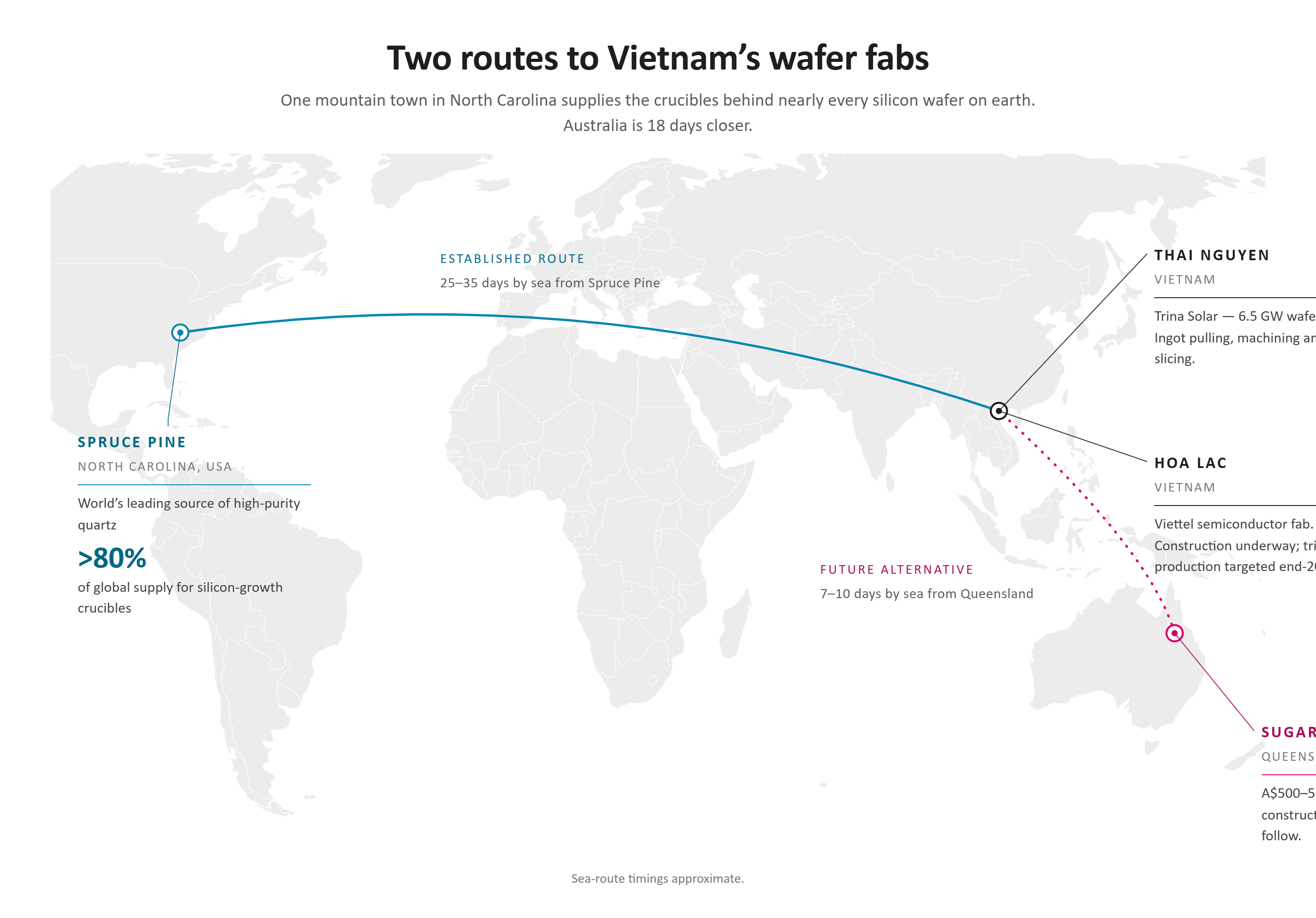
The North Carolina route is established. The Queensland route depends on financing, construction and customer approval. Map: VNANZ Capital.
Queensland Owns the Resource. Carolina Owns the Customer
Sugarbag Hill in northern Queensland is Australia’s most advanced response to the Spruce Pine concentration.
The proposed development is costed at A$500 to 550 million in its December 2024 pre-feasibility study and would include a quarry, processing facilities, a pilot plant and export infrastructure. In April 2026, Queensland declared it a prescribed project, giving the development coordinated government support (Queensland government, Investing News Network).
But government support does not make Sugarbag Hill a supplier.
It does not finance construction.
It does not guarantee that commercial processing will reproduce laboratory results.
And it does not persuade a manufacturer to place an untested product beside a valuable silicon melt.
The project is targeting a final investment decision in 2027 and construction in 2028.
Production comes later.
Customer approval later still.
That sequence is the investment case.
A tonne of quartz in the ground is an opportunity. A tonne approved for silicon manufacturing is a product.
Only the second generates premium revenue.
Australia’s prospective product is not merely another source of sand. It is supply insurance.
For a wafer manufacturer, depending on one concentrated district creates a risk far greater than the price of the quartz itself. An interruption can idle furnaces, delay deliveries and reduce the return on an expensive manufacturing asset.
A second approved supplier could remain valuable even if its material costs slightly more.
The question is not simply:
Who sells the cheapest quartz?
It is:
What will a manufacturer pay to reduce the risk of an idle furnace?
That is Australia’s opportunity.
The problem is timing.
Trina’s furnaces are already running. Viettel wants trial production by the end of 2027. Sugarbag Hill does not expect to begin construction until 2028.
And construction does not equal supply.
The processing plant must be commissioned. The chemistry must hold at scale. Samples must reach customers and survive qualification.
By the time Queensland is ready, Vietnamese buyers may have extended incumbent contracts, qualified Chinese material or chosen another route.
The map makes Australia look close to Vietnam.
The calendar makes it look much further away.
The Toll Is Not Waiting
Three developments will show whether Australia is closing the gap.
The first is a final investment decision at Sugarbag Hill, and the date to mark is 30 June 2027. Until capital is committed, Queensland owns a development opportunity, not an emerging supplier.
The second is customer participation. Another purity result shows technical progress. Customer-funded testing or an offtake agreement would show commercial intent.
The third is another ingot-pulling investment in Vietnam, and the date to mark is 31 August 2027. Another module plant would add little to this thesis. Another furnace would create recurring crucible demand.
The base case is that Australia will not supply meaningful commercial volumes of qualified crucible-grade quartz before 31 December 2028.
That does not eliminate the opportunity.
It means Australia may miss the first purchasing window.
The most revealing part of Hurricane Helene was not that two quartz producers stopped.
It was that flooding in one small American town briefly became a question for the global technology industry.
The mines restarted.
The dependence remained.
Since then, Trina has started pulling ingots in Vietnam. Viettel has started building a fab. Australia has started advancing a possible alternative.
Only one of those supply chains is already qualified.
In North Carolina, the material is moving.
In Vietnam, the furnaces are running.
In Queensland, the alternative remains on paper.
The next two years will decide whether that paper becomes a purchase order.
Until then, the crucibles will keep wearing out, and the orders will keep flowing to suppliers customers already trust.
The toll is not waiting for Australia.
Up next: Hanoi’s for-sale list. Decision 40 gave 19 state groups their sell-down orders. 6 September 2026.
General commentary only. Not financial product advice.