The Vietnam-Australia trade nobody is writing about
Vietnam joins the emerging market index on 21 September 2026. Australia's A$4.5 trillion super is already hunting offshore. These two stories should be colliding but are currently not.
The meeting was held on a Wednesday in late March. Colin Mullins, group CEO of Vantage Point Asset Management, had flown in from Ho Chi Minh City the night before. A delegation from the newly launched Vietnam International Financial Centre sat alongside him.
The pitch was direct: help build a US$10 billion (A$15.3 billion) capital base for Vietnam over five years. Long-dated, large-ticket, institutional. The kind of mandate a major Australian super fund is built to take on.
Two super funds sent their junior staff where the only English-language coverage was a short item in VnEconomy and a brief note in Vietnam News. Nothing in the Australian Financial Review. Nothing in Capital Brief. Nothing in any publication that Australian institutional capital actually reads. Six months from now, something much bigger arrives. Almost nobody is writing about that either.
2. Vietnam’s FTSE upgrade
On 21 September 2026, Vietnam joins the FTSE Russell Secondary Emerging Market index. The largest single change to the global emerging market benchmark in a decade.
It’s roughly US$18.1 trillion sits in funds with Vanguard’s FTSE Emerging Markets ETF alone holding over US$100 billion. Hence, when an index reclassifies, the funds that track it have no discretion. Their job is to hold the same stocks the index holds, in the same proportions. If the index says Vietnam is 0.35% of the emerging market universe, the fund has to hold 0.35% of its money in Vietnamese stocks, regardless of whether those stocks look cheap, expensive, or fairly valued.
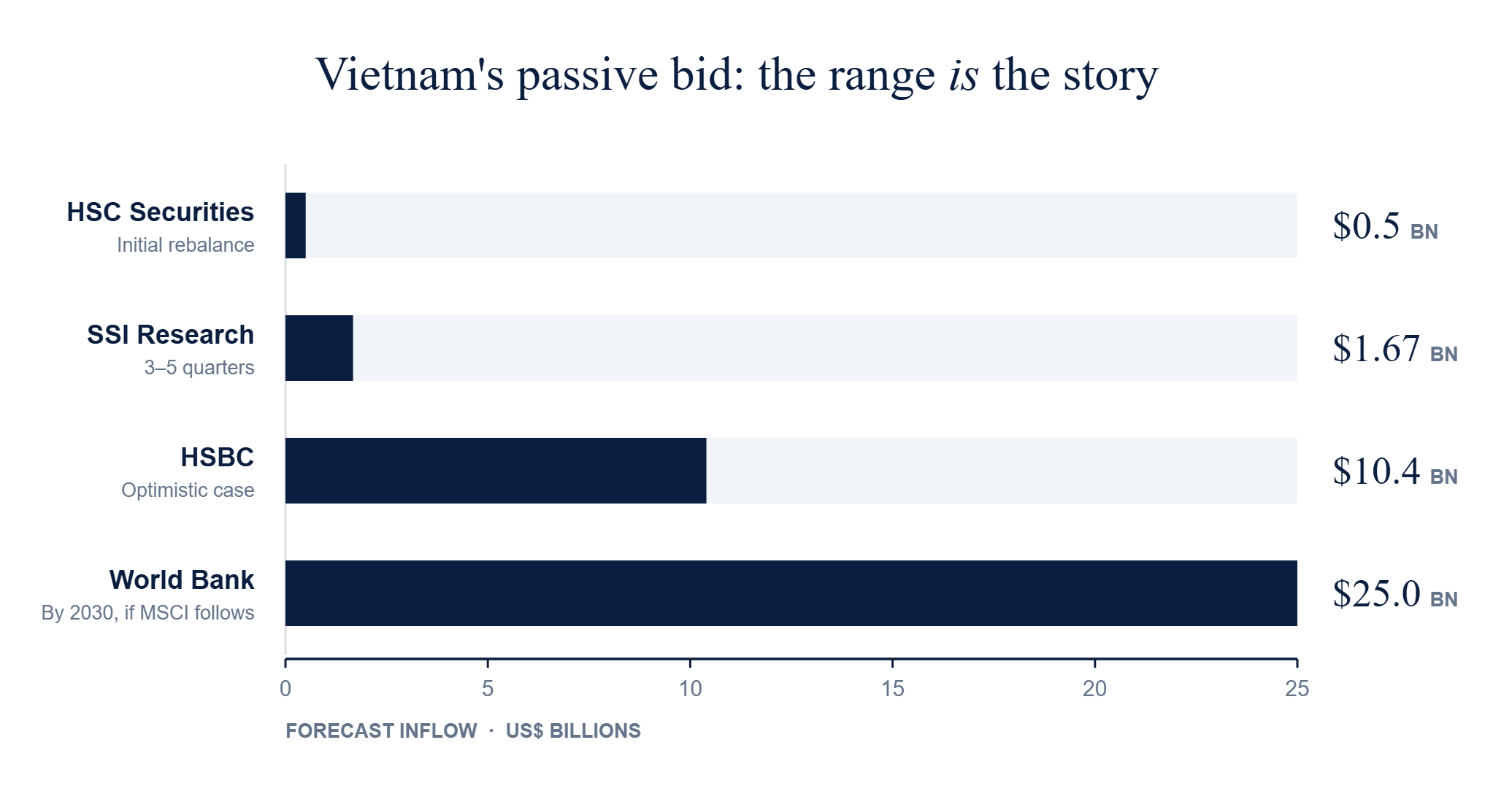
Now, how much passive money that actually drags into Vietnam is where the sell-side disagrees. Estimates of inflow over the twelve months following the effective date range from US$1.7 billion (SSI Research) to US$10.4 billion (HSBC). In addition, to The World Bank projects cumulative inflows of US$25 billion by 2030 if MSCI follows with a second upgrade.
Source:HSC Securities, SSI Research, HSBC Global Research, World Bank.
Given this the FTSE has identified 28 to 32 Vietnamese stocks as eligible for the index, but seven of them will absorb most of the funds: Vingroup, Vinhomes, Hoa Phat, Vietcombank, Masan, Vinamilk and FPT. Not all of that money will actually land on those stocks. Every Vietnamese listed company has a cap on how much of its foreigners are allowed to own some 100%, some 30% or less. Once the cap is hit, foreign investors cannot buy any more shares at the listed price, no matter how much money they have.
However, whether this actually pushes Vietnamese share prices higher depends on precedent. Saudi Arabia joined the FTSE emerging market index in2019 and drew roughly US$14 billion in the following twelve months. Kuwait joined in 2020 and drew US$3 billion. This ultimately position Vietnam between the two in market size, which is why the higher-end forecasts are taken seriously.
3. Australian super: A$4.5 trillion, looking offshore
Vietnam is being pulled in by global index reforms. FTSE Russell has had Vietnam on its emerging-market Watch List since 2018, and MSCI continues to flag the market for reclassification. Meanwhile, Australia is sitting on A$4.5 trillion in superannuation assets, with international equity allocations now around 48 percent, a record high. Emerging markets make up just 5 percent of that offshore book.
Domestic super ownership of the ASX is past a third and rising, which is why the next decade of returns will be decided offshore. Of the obvious destinations, most developed markets are already saturated with Australian capital. The largest emerging markets, China especially, carry political and geopolitical complications super funds are increasingly unwilling to wear. India offers scale but is structurally hard to access. Indonesia is closer but less institutionally developed.
Vietnam, by contrast, is institutional-ready, structurally accessible and on a credible upgrade pathway. With GDP growth tracking around 6.5 percent, a working-age population of roughly 67 million, a stock market capitalised over A$310 billion, and A$26 billion in bilateral trade with Australia. Therefore, over the next decade, Vietnam is positioned to become one of the most attractive destinations for institutional capital in Southeast Asia, and a significant share of that capital will flow from Australia.
4. Already moving in silence: three deals, three sectors
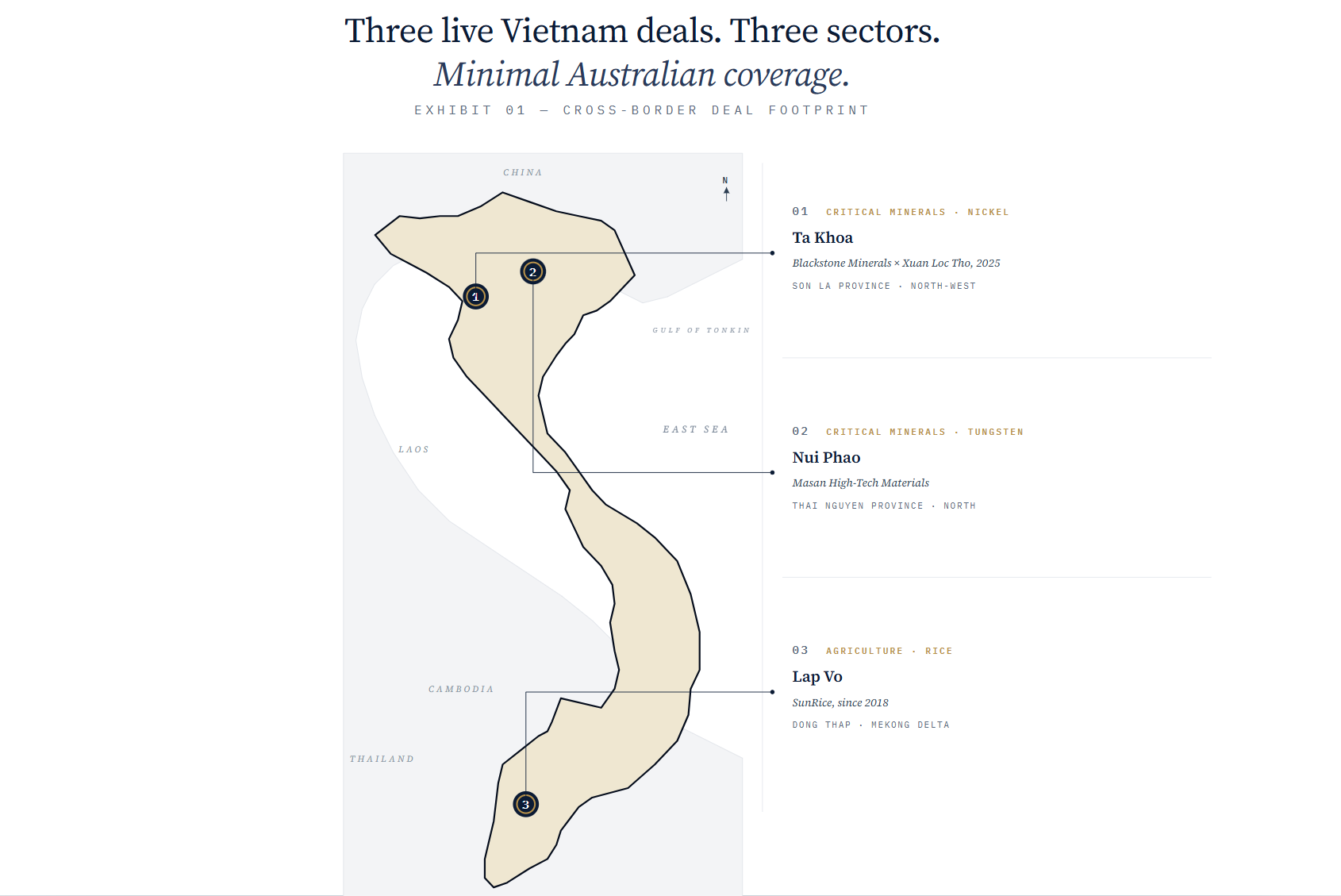
Currently, the coverage gap is not because there are no deals to write about. The deals are already happening. They are just happening in silence:
In August 2025, Blackstone Minerals (ASX:BSX) signed a binding partnership with Vietnamese conglomerate Xuan Loc Tho, which took a 55% interest in the Ta Khoa nickel project in northern Vietnam. The announcement landed on the ASX on a Wednesday afternoon and moved almost no headlines.
Masan High-Tech Materials operates the Nui Phao mine in Thai Nguyen, which is the largest tungsten producer outside China. Its tungsten supplied roughly 22% of US tungsten imports in 2024. A Vietnamese company producing a strategic mineral that Western supply chains depend on, and almost no Australian investor could name it.
SunRice (ASX: SGLLV) has run its Lap Vo mill in the Mekong Delta since 2018. It now handles around 260,000 paddy tonnes a year and carries more 50% of Vietnam’s Japonica-style exports. SunRice’s 1H FY26 net profit was up 14% to A$36.6 million, driven in part by Vietnamese supply chain economics.
Nickel. Tungsten. Rice. Three sectors, three live deals, three counterparties most Australian investors could not name. The 2025AusCham survey found 61% of Australian businesses in Southeast Asia rank Vietnam as their top expansion market with the highest share in ASEAN.
What no one is writing about
Vietnam and Australia are entering their most active phase of bilateral capital flow in modern history. Deals are happening. Capital is moving. Australian super funds are searching for emerging market exposure. And yet the people whose job it is to write about this are writing about something else.
“The person that turns over the most rocks wins the game.”
— Peter Lynch, One Up on Wall Street (1989)
Lynch ran Fidelity’s Magellan Fund and averaged 29% returns a year for thirteen years. He didn’t do it by reading the same broker reports as everyone else. He drove out to see the companies himself and looked where others weren’t looking.
The Vietnam-Australia story is exactly that kind of place. That is the space VN & ANZ Capital is built to cover.
Here is how the major outlets handle it:
DealStreetAsia covers both countries, but in separate streams that never connect
Nikkei Asia writes about Vietnam mostly for a Japanese investor audience
The AFR, Capital Brief, and The Australian’s DataRoom cover Australian M&A, where Vietnam appears only as a footnote to China or ASEAN stories
The Lowy Institute publishes policy analysis, but without the deal-level detail investors need
Vietnam Weekly is the best English-language news source on Vietnam, and openly says it is not a finance publication
Five credible outlets. None of them connecting the two sides. That is the gap this publication is built to fill.
Thanks for reading! Subscribe for free to receive new posts and support my work.