



Anyone who followed Tasmanian politics in the 2000s knows Bell Bay. Gunns, the timber company, spent years trying to build a pulp mill on that stretch of the Tamar River. It got its approval and lost most of the community along the way. The foundations were never poured, and by 2012 Gunns was in administration.
On 25 August this year George Town Council voted six to one for a very different neighbour: a 288MW AI data centre. The peace lasted a few weeks. The developer has since appealed against conditions limiting how it uses its diesel backup generators, the ABC reported, and the AFR says local pushback is slowing its Tasmanian plans.
That developer is Firmus Technologies. Tim Rosenfield and Oliver Curtis started it in 2019, and Curtis, a former stockbroker, put in about A$250,000 at the beginning, according to Startup Daily. This month the same company wants the market to value it at about A$43.7 billion. It has priced its float at A$11 a share, is raising about A$7 billion, and lists on the ASX as AIF on 23 October. Only Telstra's float was bigger. Nvidia and Blackstone are on the register with about 7.2 percent and 6.7 percent, the AFR reported.
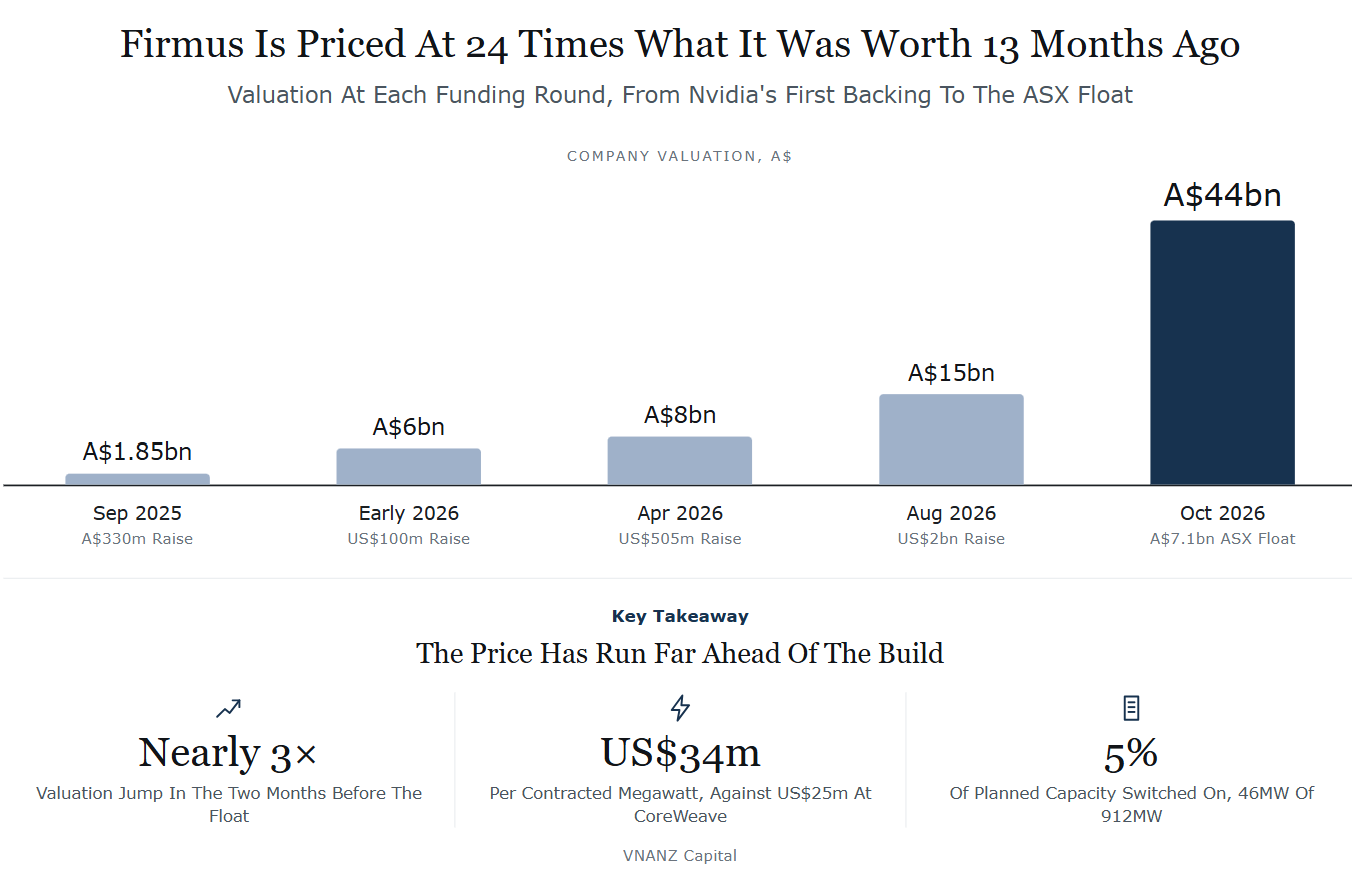
So, have investors lost their minds? I don't think so. But they are being asked to pay before the hard questions have answers.
It has not been a quiet week either. On 6 October CDC, the operator that was meant to build much of Firmus's Australian network, confirmed the two had ended Project Southgate, their plan for 1.6GW across six Australian locations. Melbourne will stay at the 42MW Firmus has delivered, which Meta uses. It was supposed to grow to 150MW, Startup Daily reported. Firmus says none of this touches its development plans or its contracted capacity.
Gunns had a plan and never got a building. Firmus has the customers, Meta and OpenAI among them. Now it has to deliver the buildings and the chips.
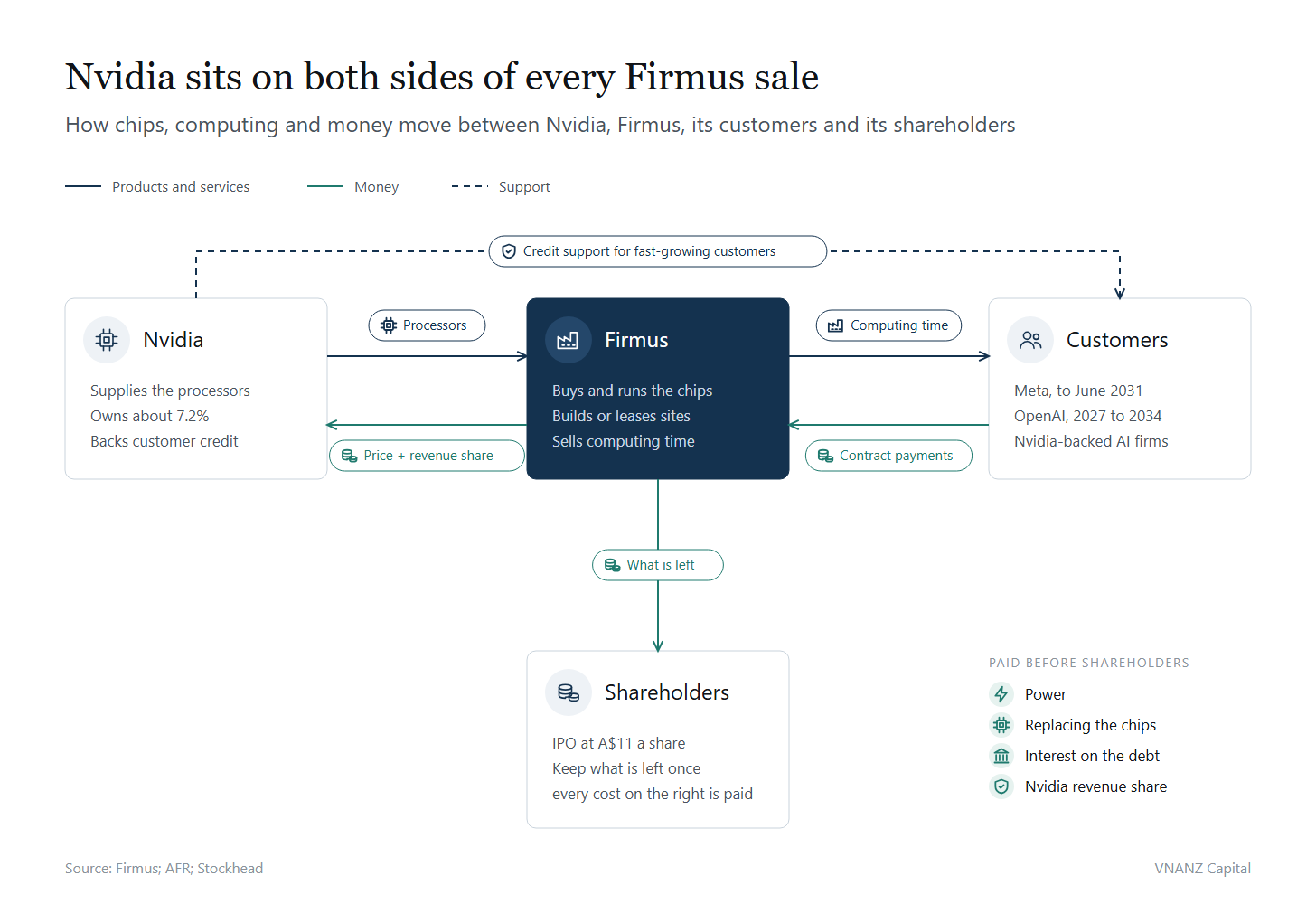
What Firmus actually sells
Start with a company most ASX investors know. NEXTDC builds and runs the facility: land, buildings, power, cooling. Customers wheel in their own servers and pay rent for space and electricity, usually on long contracts. NEXTDC spends its capital on assets that last decades. It has plenty left to build too. Of the 740.1MW of contracted utilisation it reported at 30 June, 175MW was billing and 565.1MW was still in the forward order book.
Firmus takes on more of the job. It designs and prefabricates liquid-cooled modules in regional New South Wales, buys and installs the Nvidia systems, then sells the computing power those systems produce. Meta's September deal was for GPU compute capacity, and floor space never came into it. The industry calls this a neocloud. The closest listed comparison is CoreWeave in the United States, because nothing on the ASX looks like it.
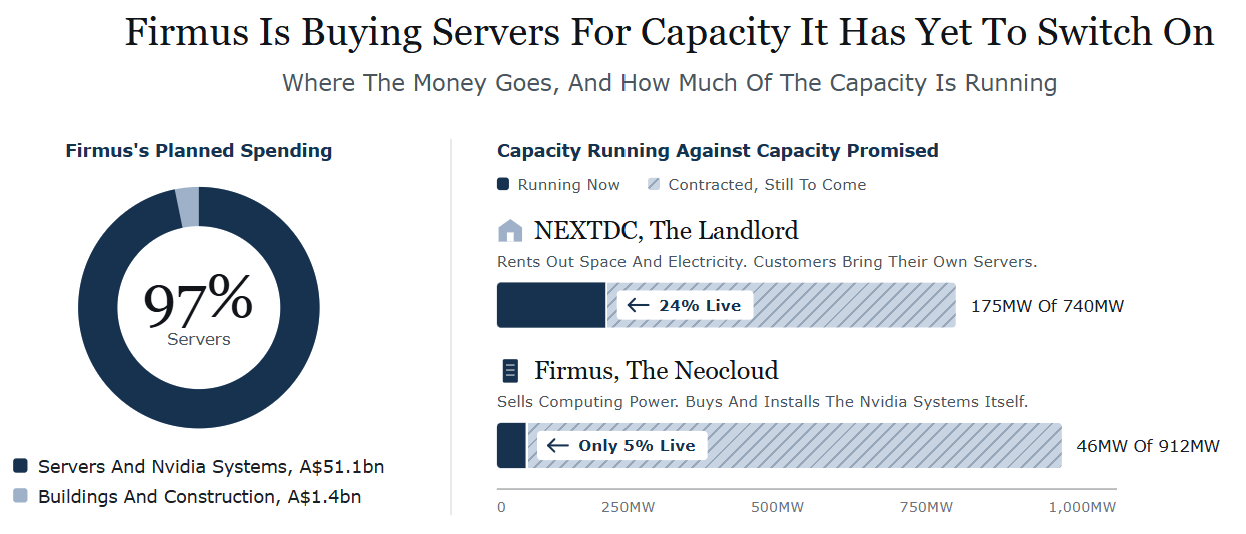
You can see the difference in the spending plan. Firmus's forecasts, as reported by Stockhead, include about A$51.1 billion for servers and A$1.4 billion for construction. Roughly 97 percent of the money goes into computing equipment.
What the A$11 price has to pay for
The same forecasts show a fully operating Firmus earning about A$19.2 billion of revenue and A$17.3 billion of EBITDA, a margin of about 90 percent. In 2027, with only Melbourne and Singapore running, the margin is about 62 percent. Numbers like these make a A$44 billion valuation possible.
I'd be careful about valuing the company on them, though. EBITDA leaves out depreciation, and depreciation is the biggest cost in this business because the chips wear out.
Some rough arithmetic shows how much that matters. Write off A$51.1 billion of servers over five years and the annual charge is about A$10.2 billion. That takes A$17.3 billion of EBITDA down to roughly A$7.1 billion before interest and tax. Use four years and you get about A$4.5 billion. Use six and it is about A$8.8 billion. Firmus's own reported forecasts of earnings after depreciation for its Indonesian and two Malaysian projects add up to about A$6.1 billion, which sits inside that range. These are my own sums from reported forecasts, and Firmus has not published them as guidance. They also come before tax, and before interest on whatever debt pays for the servers.
Shareholders face two more costs before any of that reaches them. One is Nvidia. Under the Batam partnership Nvidia earns its normal product revenue on the systems Firmus buys, and it takes a share of the cloud revenue Firmus earns on the supported capacity as well. The companies call this a revenue-sharing and credit-support model. I want the prospectus to show whether the reported margins are struck before or after Nvidia's cut. The other cost is power, the main operating expense in any data centre and the reason Firmus is fighting over its generators in Tasmania.
Who pays for the next generation of chips
The contracts Firmus has disclosed run for different lengths. Meta's cloud services agreement began in February 2026 and ends in June 2031. Nvidia's initial Australian order finishes in January 2031. OpenAI has committed to capacity between 2027 and 2034, Stockhead reported. At Batam, Firmus expects about A$36 billion to A$43 billion from committed offtake over six years.
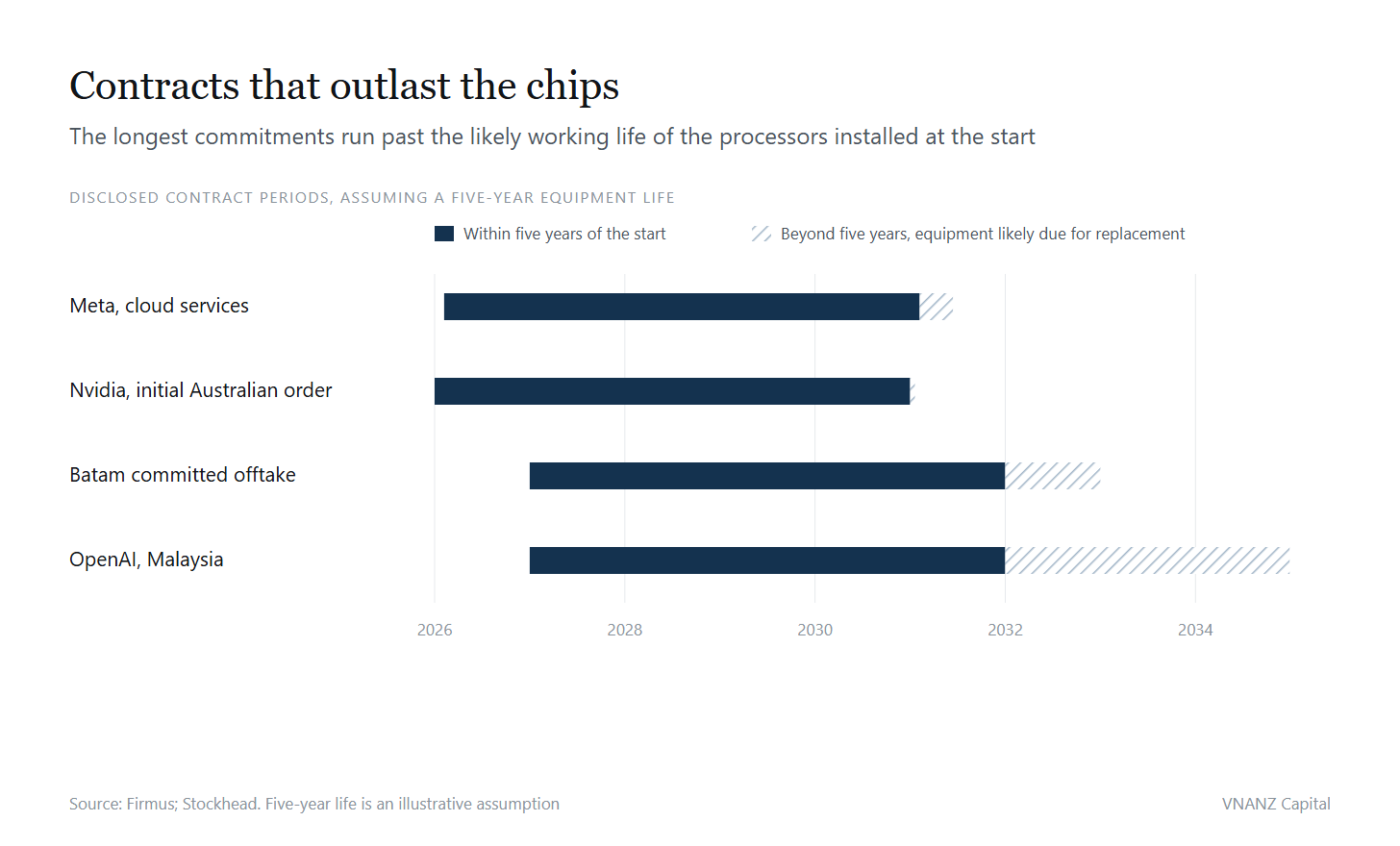
OpenAI's contract is the one I'd study hardest. Nvidia now ships a new generation of systems every year or two, so a deal running to 2034 will almost certainly outlive the processors installed on day one. If OpenAI expects current-generation performance the whole way through, somebody pays for the upgrades. A contract price that steps up with each refresh protects shareholders. A fixed price that leaves Firmus replacing equipment out of its own pocket turns the same contract into a liability. The prospectus needs to tell us which one this is.
Where the capacity is, and where it is not
Firmus has seven AI factories across Australia, Singapore, Malaysia and Indonesia. The biggest is the 360MW Batam campus, which it is developing with DayOne, a Singapore-based platform. Batam targets first operations in the first quarter of 2027, with Nvidia systems going in through 2027 and 2028. Two Malaysian sites near Kuala Lumpur will serve OpenAI, with construction finishing in phases from 2027 into 2028. Firmus hasn't yet said how many of its 900-plus contracted megawatts sit at each stage of development.
Readers of this newsletter will notice the gap in that list. Firmus has projects in Malaysia and Indonesia and none in Vietnam, and the announcements alone don't explain it. The projects next door went ahead on three things: power that connects at scale, binding customer commitments, and financing built on those commitments. Vietnam's developers will be measured against the same list. VNANZ looked at those conditions in Ho Chi Minh City on 5 October.
What the prospectus has to answer
The offer document is due this week. I'll be reading it for four things, and the headline valuation isn't one of them.
Equipment life comes first: how long Firmus assumes its servers last, and whether its contracts are priced to cover replacing them. Then Nvidia's revenue share, and whether the margins are quoted before or after it. Then the financing of the servers and the interest bill that comes with it. Last is customer concentration, meaning how much of the contracted revenue comes from the two or three biggest names.
What to watch through 2028
After the float, three things will tell us whether the forecasts are holding. Batam is the big one. Does it start operating in the first quarter of 2027 as targeted, and how fast does the full 360MW follow through 2028? Closer to home, the generator appeal at Bell Bay will give an early read on how quickly Firmus can build its Australian sites without CDC. Then comes the first annual report as a listed company, where we see actual margins and depreciation in place of forecasts.
So back to the question. Investors paying A$44 billion haven't lost their minds. The customers are real and the margins before depreciation are extraordinary. But this is a business that has to buy, run and replace tens of billions of dollars of chips, and what shareholders keep depends on who pays for the next generation of processors. I'd want that answer in writing before the float.
General commentary only. Not financial product advice. Information current to 6 October 2026